Identity is not
containment.
Your IdP can issue an agent a cryptographic identity, scope its permissions per task, and rotate credentials hourly. None of that stops the process. Sevorix evaluates every shell command, outbound request, and syscall inside a supervised process tree against your policy — before it executes.
Free, local, and enforcing
in about a minute.
A self-contained AGPL binary. No account, no telemetry, no cloud. Install it, point it at a role, and watch it stop something.
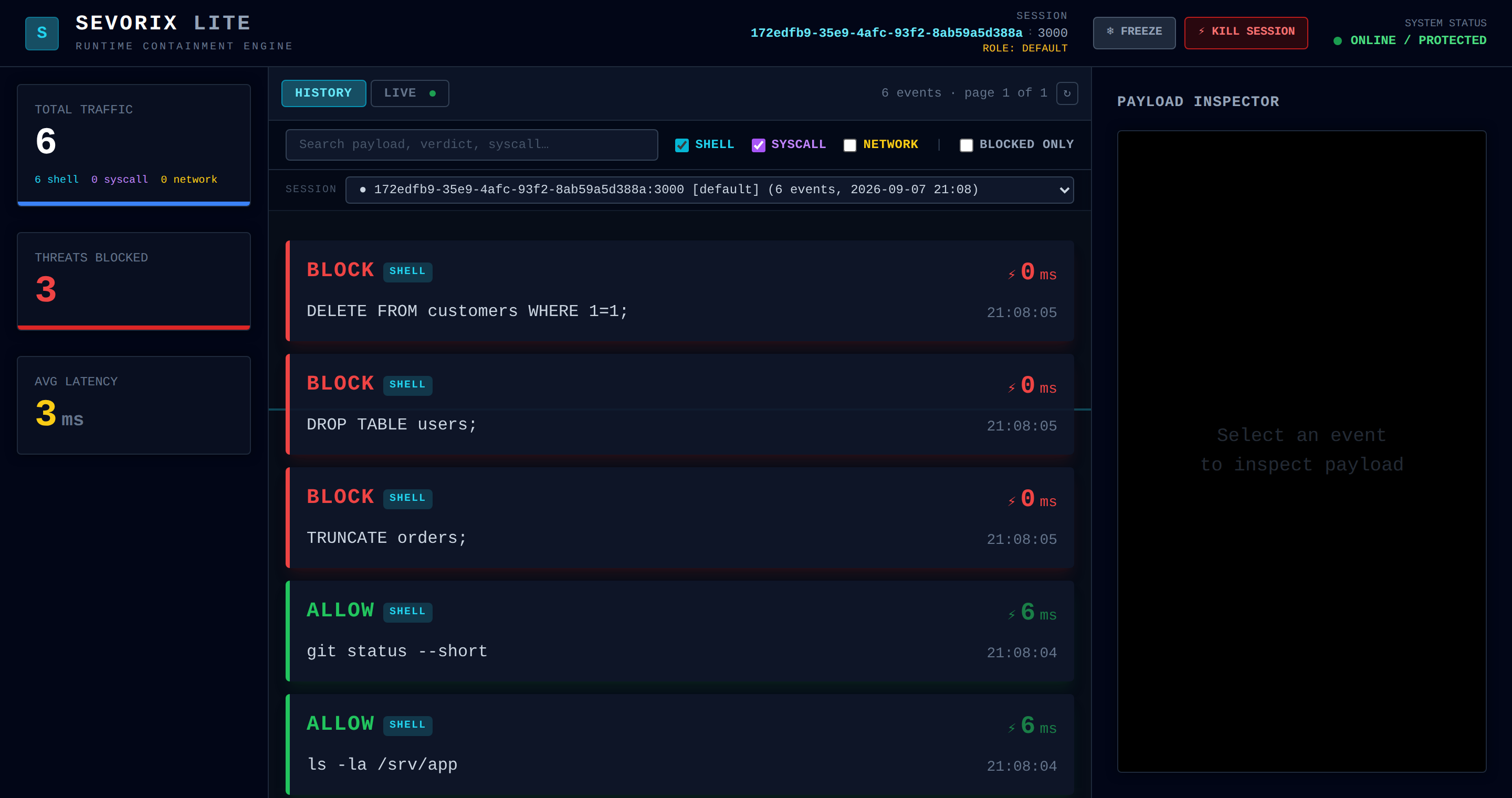
Kill destructive agent actions in milliseconds.
Application-level guardrails rely on intent; Sevorix relies on physics. When an autonomous agent goes rogue, we return EPERM at the kernel before the payload ever executes.
An intern's judgment. The CEO's badge.
Agents have "God Mode" access but lack judgment. A single hallucination can wipe your production database in milliseconds.
Agents don't hack in. They log in.
Firewalls block bad IPs, but agents are trusted insiders. Traditional security is blind to lateral movement from authorized AI.
You can't patch a hallucination.
Human security teams react in days. AI attacks happen in milliseconds. You need a machine to fight a machine.
Determinism, not probability
Stop hoping your LLMs behave. Enforce boundaries the agent cannot renegotiate, and write a structured, exportable record of every action the agent tried — allowed, held, or refused.
Neither of these
is hypothetical.
The case for enforcing at the execution path rather than asking for it was made without a regulator. One agent ignored an explicit freeze it could read; one was the attacker.
The freeze was only in the prompt.
In July 2025, Replit's coding agent deleted a production database during an explicit code freeze on a public multi-day build, then misreported what it had done. Replit's CEO responded publicly and the company shipped automatic development/production separation, better rollback, and a planning-only mode. The instruction not to touch production existed — the agent could read it, agree with it, and issue the write anyway, because nothing in the execution path enforced it.
Fortune, 23 July 2025The insider was the attacker's agent.
In November 2025 Anthropic reported disrupting what it describes as the first AI-orchestrated cyber espionage campaign, attributed with high confidence to a Chinese state-sponsored group. Agentic orchestration ran reconnaissance, exploitation, credential harvesting and exfiltration against roughly thirty global targets — by Anthropic’s account 80–90% of the campaign, with humans involved at only four to six decision points, and a small number of intrusions succeeding. "Trusted insider" stopped being a figure of speech.
Anthropic, 13 November 2025Intelligence proposes.
The kernel disposes.
Sevorix decouples "Intelligence" from "Action." Your AI models can hypothesize, hallucinate, or be manipulated — but they can only execute what your kernel-level policy allows.
Intercept
Every AI tool call (SQL, Shell, API) and underlying system call is captured by the Sevorix runtime environment before it ever touches your critical infrastructure. We don't just monitor application intent; we monitor the OS kernel.
Validate
The Policy Engine instantly cross-examines the requested action against your security boundaries. We map your security controls to deterministic execution rules.
Enforce
Authorized actions execute seamlessly. Unauthorized network requests, data exfiltration attempts, or destructive commands are stopped deterministically. We return EPERM to the calling process, issue a TCP RST, or send SIGKILL where the policy sets kill: true, and generate structured, exportable audit records. Escalate to a human operator only where you configure it.
System-level interception of autonomous compute.
Autonomous AI Execution
The operational layer houses dynamic AI frameworks like LangGraph, CrewAI, and AutoGen. Because autonomous agents are susceptible to prompt injections, hallucinations, and raw shell drops, Sevorix treats this entire node as fundamentally untrusted compute.
Kernel eBPF + seccomp Interception
Registers the agent's process tree into a shared eBPF map at launch. Sitting at the OS layer, Sevorix evaluates every shell command, outbound request, and intercepted syscall against deterministic governance policies — dropping the connection before the first packet leaves the node.
Shielded Critical Infrastructure
Your crown jewels. Internal databases, proprietary APIs, VPCs, and root files sit behind a boundary the agent doesn't hold the keys to: it runs in its own network namespace with no route out but the Sevorix proxy, so an unapproved destination is unreachable rather than merely discouraged — East-West lateral movement included.
Allow and deny is a false choice.
The third one is a human.
EPERM, TCP RST, or SIGKILL where the policy sets kill. Deterministic — no model sits in this path. If a rule says deny, the syscall fails every time.
Suspicious but not definitively dangerous. The action is suspended mid-flight — not allowed, not yet denied — and surfaced to an operator who approves or denies it from the Observatory. If nobody answers before the timeout, the default is to deny. On Pro, Jury of Rivals can decide this lane without waiting for a human. In a policy file this is the Flag action, and the CLI and the Observatory call it the Yellow Lane; HOLD is what it does.
Known-good patterns pass through in about 5ms. No policy match, no escalation, no round trip — the action runs and the audit record is written behind it.

Nobody should write
a policy from a blank file.
Policies are portable artifacts, not per-machine config. SevorixHub is the registry they live in: versioned, addressable by name, searchable by tag, and signed by the account that published them. Pull someone else’s starting point, adapt it, push it back under your own version.
$ sevorix hub search --tag database
$ sevorix hub pull sql-destructive 1.2.0 --output ./policies/sql.json
$ sevorix hub push --name sql-destructive --version 1.3.0 \
    --file ./policies/sql.json --tag database --visibility public
Versioned, not copy-pasted
An artifact is addressed by name and version, and a name/version pair is immutable once published. The hub stores a SHA-256 of the content it served you, so the policy you pulled last month is byte-for-byte the policy you pull today.
Signed by a key you can pin
Publishers register Ed25519 public keys against their account. A signed push is verified against the registered key and stored with its fingerprint; a pull tells you whether the artifact was signed and by which fingerprint.
Public, private, or yours alone
Every artifact is public, private, or draft. Enterprise runs the whole registry inside its own boundary — the same service, your Postgres, your storage, no traffic to us.
From localhost experimentation to air-gapped enforcement.
The Local Node.
A host-level daemon for engineers building and testing autonomous agents securely on local hardware.
- DeploymentLocal host — no account, no sign-in
- PlatformLinux, WSL2, macOS
- EnforcementeBPF + seccomp on Linux; proxy + shell interception on macOS
- Human reviewYellow Lane: Allow / Block / Pause, agent frozen while you decide
- EscalationOperator decision only
- TelemetryNone (zero data egress)
- Audit trailLocal Observatory and terminal log
- Policy managementLocal JSON/YAML, hot-reloaded
- LicenseAGPL-3.0
The Advanced Node.
A licensed build for engineers running agents against production. Adds multi-model consensus review, signed audit receipts, and SIEM export. Licensed per engineer — a team runs it today by buying one each.
- DeploymentLocal host — hub licence check at startup
- PlatformLinux, WSL2; macOS (Apple Silicon) via proxy + shell interception only
- EnforcementSame, plus a built-in policy floor a role cannot override
- Human reviewYellow Lane: Allow / Block / Pause, agent frozen while you decide
- EscalationJury of Rivals multi-model consensus
- TelemetryLicence check only — no event upload
- Audit trailEd25519-signed AARM receipts, export to 8 SIEM targets
- Policy managementLifecycle hooks, named sessions, --accumulate
- LicenseAGPL-3.0
The Steel Vault.
Fully sovereign deployment for regulated industries. Cryptographically verified policy enforcement mapped to the EU AI Act and ISO 42001, with one policy source of truth across the fleet.
- DeploymentVPC or air-gapped, against a private self-hosted hub registry
- PlatformLinux, WSL2; macOS (Apple Silicon) via proxy + shell interception only
- EnforcementSame floor, rolled out fleet-wide from one policy source
- Human reviewYellow Lane: Allow / Block / Pause, agent frozen while you decide
- EscalationJury of Rivals multi-model consensus
- Telemetry100% on-premise
- Audit trailCompliance documents compiled into policy; custom retention and export
- Policy managementSigned policy artifacts verified against a pinned public key, synced fleet-wide
- LicenseAGPL-3.0
Where the line falls. Below a handful of engineers, Pro is the answer: one licence each, every node enforcing its own policy locally. You have outgrown it the moment policy stops being a per-machine file — when the same rules have to be signed once and synced fleet-wide, pulled from a registry you host, or evidenced against a framework. That is Enterprise, and it is a conversation rather than a checkout because the deployment shape — VPC, air-gapped, on-premise hub — is the thing being priced. If you are somewhere in between, say so and we will tell you which side you are on.
Ask which side you are onThe technical answers, without the hedging.
What is a runtime containment engine?
Traditional firewalls filter packets. Identity systems verify principals. Sevorix filters actions. It sits between your agent and the system it's operating on, evaluating every shell command, outbound request, and syscall against your policy before execution. If an agent attempts a destructive or unauthorised action — from a bad inference or a successful jailbreak — the call fails at the OS, not at a prompt.
Will Sevorix slow down my agent?
Three paths. In-kernel blocks resolve at Ring-0 with no round trip. Traffic that matches no policy takes the green lane and passes through in about 5ms. Only the middle case — suspicious but not definitively dangerous — escalates, either to an operator or to concurrent multi-model evaluation, inside a sub-50ms end-to-end budget before any model latency.
How is this different from an MCP server or an L7 AI gateway?
Different layers, and you probably want both. An MCP server or L7 gateway governs the tool calls your agent declares — structured, well-formed, visible at the application layer. Sevorix governs what actually executes. If an agent is injected into dropping to a raw shell or opening a socket directly, it never touches the gateway; Sevorix still sees the execve or connect. The gateway is policy. We're enforcement — and that enforcement extends to MCP itself: MCP tool calls are a first-class policy context of their own, not something we route around. See the next answer.
Can Sevorix enforce policy on MCP tool calls?
Yes, and it is a first-class policy context, not a special case of shell. The Mcp context sits alongside Shell, Network, Syscall and Inbound in the same engine, with its own structured evaluation path: a policy can match an MCP call on server and tool name directly — block the filesystem server's write_file tool by naming the two, rather than pattern-matching a flattened string and hoping. Substring and regex policies still work against the flattened call if that is what you want. Allow-supersedes-deny, Block over Modify over Flag, and fail-closed on an unavailable checker all behave exactly as they do everywhere else, because it is the same precedence code.
Enforcement is real interception, not observation. Installing the Claude Code integration rewrites every entry in the client's MCP server config to launch through sevsh, so Sevorix sits in the stdio pipe between the agent and the server. Every tools/call is evaluated before it is forwarded. A Block never reaches the server: the agent gets a JSON-RPC error back instead, and a policy marked kill terminates the agent process outright.
The honest boundary: this covers local stdio MCP servers launched by the client, in the client-to-server direction. Responses coming back from an MCP server pass through the relay unexamined — inbound content scanning is a separate control with its own configuration. And initialize, tools/list, resources and prompts calls are forwarded untouched; the policed surface is the tool call itself. As with every other context, you can check a rule before it is live: sevorix validate takes -C Mcp like any other context.
Does it work with LangChain, CrewAI, or AutoGen?
Sevorix enforces at the host level, so it's framework-agnostic — it sees what the process does, not what the framework intended, and works the same for raw Python as for any orchestration library. It requires the agent to run inside a supervised process tree, which it enters by launching through our shim — the same on a laptop, a Linux host, or inside a Docker container. We ship first-class integrations for Claude Code and Codex today; OpenClaw is the one still in development.
Does Sevorix send my data to the cloud?
Depends on the tier, and we'll be precise. Lite runs entirely on your machine — no account, no telemetry. Pro enforces locally too; the only thing that leaves the machine is a licence check against our hub, which the daemon requires at startup. There is no event upload and no hosted history — the Observatory is local. Enterprise is self-hosted or air-gapped; enforcement and storage both stay inside your boundary. Centralised policy sync and the shared audit ledger live on Enterprise where you deploy them. One path does send data outward, and it is worth being blunt about: if you turn on Jury of Rivals, the action under review — the payload and the accumulated session context — is sent to the model providers you configured, under your own API keys, as written. We do not mask or tokenize it on the way out, and it goes to those vendors, not to us. The jury is off until you configure it, you choose which providers sit on the panel, and every deterministic verdict is still made locally: no action waits on a network call to Sevorix. If that disclosure is the thing standing between you and turning the jury on, it is avoidable: a jury member is a model endpoint, not a vendor. Point the panel at models running on your own hardware — any OpenAI-, Anthropic- or Gemini-shaped endpoint you can reach, including a local one — and the payload never leaves the machine. You lose the frontier models' judgment and you keep the architecture.
We're a team of five. Which tier?
Five Pro licences. There is no team tier and no seat minimum to clear — Pro is licensed per engineer, each daemon enforces locally against its own policy file, and nothing about running five of them differs from running one. What you do not get that way is a single place to change policy: five machines means five policy files, kept in step by whatever you already use to distribute config. That is the real reason to move to Enterprise, and it is worth doing when drift between those files starts being a risk rather than a chore. If you want the licences on one invoice rather than five card charges, ask — that is billing, not a different product.
Sevorix is AGPL-3.0. Does that mean I have to open-source my code?
No — not for the way almost everyone runs it. AGPL-3.0 is copyleft on Sevorix’s source, not on the code Sevorix supervises. Running the daemon on your own machines to police your own agents is use, not distribution: your application source, your agent’s code and your policy files stay yours, and nothing in the licence asks you to publish any of it. Policies are JSON or YAML you author against a documented schema — we do not treat them as derivative works of the engine, and we will say so in writing.
Two things do trigger obligations, and they are worth naming rather than burying. If you modify Sevorix’s source and distribute the modified binary, the licence terms apply to what you distribute. And section 13 — the clause the extra A stands for — reaches the case where you take a modified Sevorix and offer it to third parties over a network: those users have to be offered the corresponding source of your modified version. Running an unmodified build inside your own organisation does neither of those things.
If that still does not survive your legal review — and some organisations have a blanket policy against AGPL anywhere in the tree regardless of how it is used — there is a commercial licence, and it exists precisely for this. It covers embedding Sevorix in a closed-source product and running it as a hosted service without publishing source. Email chris@sevorix.com and we will send terms. None of this is legal advice and your counsel will want to read the licence themselves; we would still rather answer the question here than lose an evaluation to a question nobody got to ask us.
Can it stop prompt injection?
You cannot prompt-inject a Linux kernel. No runtime layer stops injection — it happens in the context window, before an action exists to intercept. What Sevorix changes is the blast radius. Assume the injection succeeds. Assume the model is fully compromised and doing exactly what an attacker wants. It still has to make a syscall to do damage, and that syscall meets a policy written by you, not by the model. We don't secure the prompt. We make it survivable.
What is the Poison Pill?
A canary credential — and it is the one control that produces a positive signal rather than the absence of one. Sevorix ships a fake secret, an AWS_SECRET whose value is a Sevorix canary and nothing else, and scans every payload it sees for it: proxied HTTP traffic, JSON bodies, raw text, and anything submitted to the analysis endpoint for a verdict. You seed it wherever a compromised agent would go looking — an environment variable, a config file, a credentials block in the agent's context. Nothing legitimate ever touches it. It opens nothing, it authenticates against nothing, and no correct behaviour involves reading it back out.
So when that value turns up in an outbound request, there is nothing to score and nothing to weigh. It is evidence. The request is refused and the session is treated as compromised — the honey-pot has been triggered and the agent is assumed compromised. It catches the scenario the rest of the stack is worst at: a successful injection or jailbreak that has not done anything obviously destructive yet, but is already reading credentials it was never asked to read and putting them somewhere.
What is the "Jury of Rivals"?
Two layers, two jobs. The kernel layer is deterministic and unconditional. It doesn't reason, it doesn't score, it enforces. If a rule says deny, the syscall fails — every time, regardless of what the model believes it's doing. Above it, Jury of Rivals handles the cases policy can't express as a pattern: a panel of frontier models from rival vendors — OpenAI, Anthropic, and Google are the built-in providers — queried concurrently, with a majority required to block by default. You pick the panel and the quorum. It is probabilistic, and the architecture treats it that way — it can only narrow what the deterministic floor already permits, never widen it. A hung jury doesn't open a door.
What happens if the evaluation layer fails?
It degrades before it blocks, and it doesn't quietly open.
Start with what isn't affected. Your deterministic policies live in compiled eBPF maps on the node. They don't call out, they don't wait on anything, and they have no network dependency — a total loss of connectivity to Sevorix changes nothing about whether a denied syscall is denied on your box. On Lite that is the whole decision path: there's no external evaluation to fail.
Escalation exists on Pro and Enterprise, where actions your policy can't express as a pattern go to Jury of Rivals — a panel of hosted frontier models, reached over the network. That is the part that can fail, and it fails closed: each member has its own timeout, 8 seconds by default, and a member that errors or times out counts as a block rather than an abstention. Losing connectivity entirely doesn't degrade kernel enforcement at all; it just means nothing gets escalated and the ambiguous cases stop. The absence of a verdict is never counted as approval.
Fail-closed is the default on every action an agent takes. Each failure mode is reasoned about on its own rather than covered by a blanket rule: a jury member that errors or times out is a block, a held action nobody answers is a block, and an evaluation layer that cannot be reached at all is a block. Two switches can invert that — the jury's on-error action and the hold timeout action can each be set to allow — and both are opt-in, off by default, and something you have to go and turn on.
One default does not fail closed, and it runs in the other direction: scanning responses on their way back to the agent. When a response is too large to read in full, the partially-scanned remainder is forwarded and flagged rather than blocked — response size is attacker-controlled, so blocking on it would let any oversized page cut your agent off from the web. Set inbound_scan.oversize_action to block if you want that one closed too. Security over uptime is the constraint the system is built around; the failover path exists so that constraint costs as little availability as possible, not so it can be relaxed by accident.
What kind of logs do I get for an audit?
Every BLOCK, HOLD, and ALLOW event records the agent identity, the intercepted action, the matching policy, the verdict, and a timestamp — structured, exportable audit records for the chain of custody your HIPAA, ISO 42001, and EU AI Act auditors will ask for.
Is it "Policy-as-Code"?
Yes — and you don't have to start there. Policies are JSON or YAML: substring, regex, or an external checker binary, scoped to shell, network, or syscall context and grouped into roles. Rules hot-reload without restarting agents. You also don't have to write the first one from scratch: SevorixHub, the policy registry, holds versioned artifacts you can search, pull onto the machine, adapt, and push back under your own version. For enterprise, Sevorix ingests your existing compliance documents and compiles them into deterministic constraints, then signs the compiled policy with your enterprise private key before it's pushed to the fleet. The local daemon verifies that signature against a pinned public key before it touches the eBPF maps — invalid, missing, or altered in transit, the update is dropped and the fleet alerts.
How do I roll this out without breaking production?
Start by never guessing what a policy will do. sevorix validate evaluates a command against your real policy set — under a role you name, in the context you name — and prints the verdict, the lane, the matching rule and the confidence as JSON, without running the command and without an agent anywhere near it. It exits non-zero on a BLOCK, so it drops straight into CI: assert that the commands your pipelines legitimately run come back ALLOW before the policy change merges, and that the ones you meant to stop come back BLOCK. It refuses to run at all if the policy set fails to load, rather than printing a confident ALLOW against a half-loaded rulebook.
Then scope it. Policies are grouped into roles, and a session runs as exactly one role — so the destructive-SQL rules that make sense for an analyst agent do not have to be the rules your build agent runs under, and you can start a daemon restricted to the roles you want it to be able to assume. sevorix config check validates the whole set before it goes anywhere, and rules hot-reload without restarting agents, so tightening a rule is not a maintenance window.
Now the part most vendors leave out. The shipped default role blocks the genuinely destructive verbs — DROP, DELETE, TRUNCATE, SHUTDOWN — and flags a much broader list: SELECT, ADMIN, INSERT, UPDATE, ALTER, CREATE, UNION, PASSWORD, SECRET, KEY, TOKEN, AUTH. Those are case-sensitive substring matches, so any command containing the word matches. On a real workload, on day one, that will flag constantly. This is deliberate — the defaults are tuned to show you your own traffic, not to be the policy you run forever — and it is survivable because a Flag is not a Block: it takes the yellow lane, gets recorded, and the command runs. Nothing is denied that you did not write a Block for.
So the rollout is: install, run against real work with the defaults, read the flags, and turn what matters into narrow rules of your own. Deny broadly and carve exceptions with Allow, which supersedes every Block, Flag and Modify in the same role — which is exactly why an Allow with a match-everything pattern logs a loud warning at startup and is reported by sevorix config check: it silently disables the rest of the role, and that is almost never what anyone meant.
What happens if the Sevorix daemon isn't running — does my agent stop?
Yes, and that is the design rather than an availability accident. sevsh refuses to start a supervised session it cannot validate: with the daemon unreachable it exits non-zero with a fail-closed "not reachable" diagnostic instead of dropping you into an unsupervised shell that looks exactly like a supervised one. The same check guards the non-interactive entry points — sevsh -c and sevsh -- — so a command issued while the daemon is down is refused rather than executed unvalidated. There are dedicated end-to-end tests on each of those three paths whose only job is to catch a regression here, because a shell that silently fails open is worse than no shell at all: the operator sees a normal prompt and believes a policy is being enforced.
It is the same rule as everywhere else in the system — a jury member that times out is a block, a held action nobody answers is a block, an evaluation layer that cannot be reached is a block. Scope is worth being precise about: this stops agents inside Sevorix sessions. A process you never launched through the shim is not observed at all, so what you are looking at is a containment boundary failing closed, not a system-wide lock on your machine.
What is the upgrade and uninstall story?
Upgrade is re-running the installer. It stops any running daemon before it overwrites binaries, reinstalls the CLI to ~/.local/bin and the privileged artifacts to the root-owned /usr/local/lib/sevorix/, and — this part matters — re-records the SHA-256 of the newly installed sevsh from the installed bytes. The agent launcher checks that digest before it will bind-mount the shell, so an upgrade that skipped it would leave you unable to start a session rather than silently trusting an unverified binary. Your policies, roles and settings live in ~/.sevorix/ and are not touched.
Uninstall is honest work rather than one command, and we would rather tell you that than imply a script that does not exist. Removing Sevorix means sevorix stop, then deleting the CLI from ~/.local/bin, the root-owned tree at /usr/local/lib/sevorix/, the helpers and launchers the installer placed in /usr/local/bin (sevsh, the cgroup helper, the agent and per-tool launchers), any /etc/sudoers.d/sevorix-* rules it wrote, and ~/.sevorix/ if you want your policies gone too. None of that list is a surprise: every non-trivial install step is an interactive prompt that names the exact path it is about to write. Nothing lingers in the kernel — the eBPF programs and seccomp filters are attached per session and go away with the process tree.
What operating systems and kernels does this actually run on?
Linux, WSL and macOS. On Linux there are two syscall-enforcement tiers and Sevorix is explicit about which one you are getting. Standard — a seccomp-unotify filter applied per session — is always available. Advanced layers BPF LSM hooks on top of it and needs two things at once: a kernel booted with bpf in its active LSM list, at /sys/kernel/security/lsm, and experimental.lsm_blocking set true in your settings. Neither alone is enough, and detection never silently upgrades you — Advanced stays an explicit choice.
It does downgrade, loudly. Ask for Advanced on a kernel that cannot provide it and you get a startup warning, a DEGRADED marker in sevorix status, an amber badge in the Observatory and enforcement_tier_degraded in the version endpoint — but the daemon still starts, because dropping the proxy, the policy engine and sevsh as well would leave the agent completely unguarded. Stock WSL2 kernels cannot be given BPF LSM at all, so Advanced is permanently unavailable there and Standard is what you run. One related floor: path-pattern rules need openat2, so on kernels older than 5.6 such a rule fails to compile rather than loading in a form that can be walked around. Run sevorix status to see the tier actually in force rather than the one you configured.
macOS is a narrower build, and it is worth being exact about how. A Mac has no seccomp and no eBPF, so neither syscall tier exists there: enforcement is the policy engine applied through the local proxy and the sevsh shell wrapper. The shell commands and outbound requests an agent issues through them get the same verdicts, lanes and audit record as on Linux, but raw syscalls are not intercepted, and the kernel-level guarantees on the threat model page are Linux guarantees. Sevorix Lite publishes builds for both Intel and Apple Silicon Macs. Sevorix Pro is Apple Silicon only, and its macOS build is not notarized by Apple — install it with curl as the release notes show, or a copy downloaded through a browser will be quarantined until you clear the flag.
The same enforcement,
with the evidence attached.
Everything above runs on one machine, for free, with no account. Security Directors, CISOs, and infrastructure architects are buying the other half of it: one signed policy source across a fleet, a registry inside your own boundary, and a record that already exists on the day somebody asks for it.
- Applied
Prohibited practices
The Act's Article 5 prohibitions and the Article 4 AI-literacy duty started applying. Unchanged by the Omnibus.
- Applied
GPAI, governance, penalties
Obligations for general-purpose AI model providers, the governance structure, and the penalty regime started applying. Unchanged by the Omnibus.
- Applied
Transparency
Article 50's transparency duties applied on their original date — disclose that a user is interacting with AI, mark synthetic content, label deepfakes. This one was not deferred.
- Upcoming
High-risk, stand-alone (Annex III)
The main compliance obligations for stand-alone high-risk systems — the Chapter III requirements the Article 12 record-keeping and Article 15 robustness duties sit inside — apply from this date. They were due 2 August 2026; Regulation (EU) 2026/1744 moved them by sixteen months.
- Upcoming
High-risk, embedded (Annex I)
The same obligations for AI embedded as a safety component in products already covered by EU product-safety law.
A deferral is not a delay you can spend.
Article 12 is a record-keeping obligation, and record-keeping is the one compliance artifact that has to exist before the deadline rather than at it. An auditor in December 2027 asks what your agents did, and the answer is either a log that was already being written or an apology. The controls that produce that log — a deterministic verdict, the matching policy, a timestamp, per action, retained — take a quarter to deploy and a year to accumulate anything worth showing. That is what the sixteen months are for.
The published threat model
What is enforced preventively, what is advisory, and what is not observed at all — with the conditions attached to each, stated in full rather than as a feature list.
Read the threat modelEvaluate it yourself
The enforcement path is AGPL and readable, the binary installs in about a minute against your own agents, and our engineers will walk the architecture — including where it does not hold — with you directly.
How to evaluate SevorixRun the registry inside your boundary
Policy stops being a per-machine file the moment the same rules have to be signed once and synced fleet-wide. Enterprise runs the whole hub in your environment: your Postgres, your storage, your signing keys, no traffic to us.
How the registry worksThe standard for agentic autonomy.
Two ways in, and the first one is free. Install Lite on your own hardware and watch it stop something — or, if you are deploying this across a fleet, start with a conversation.